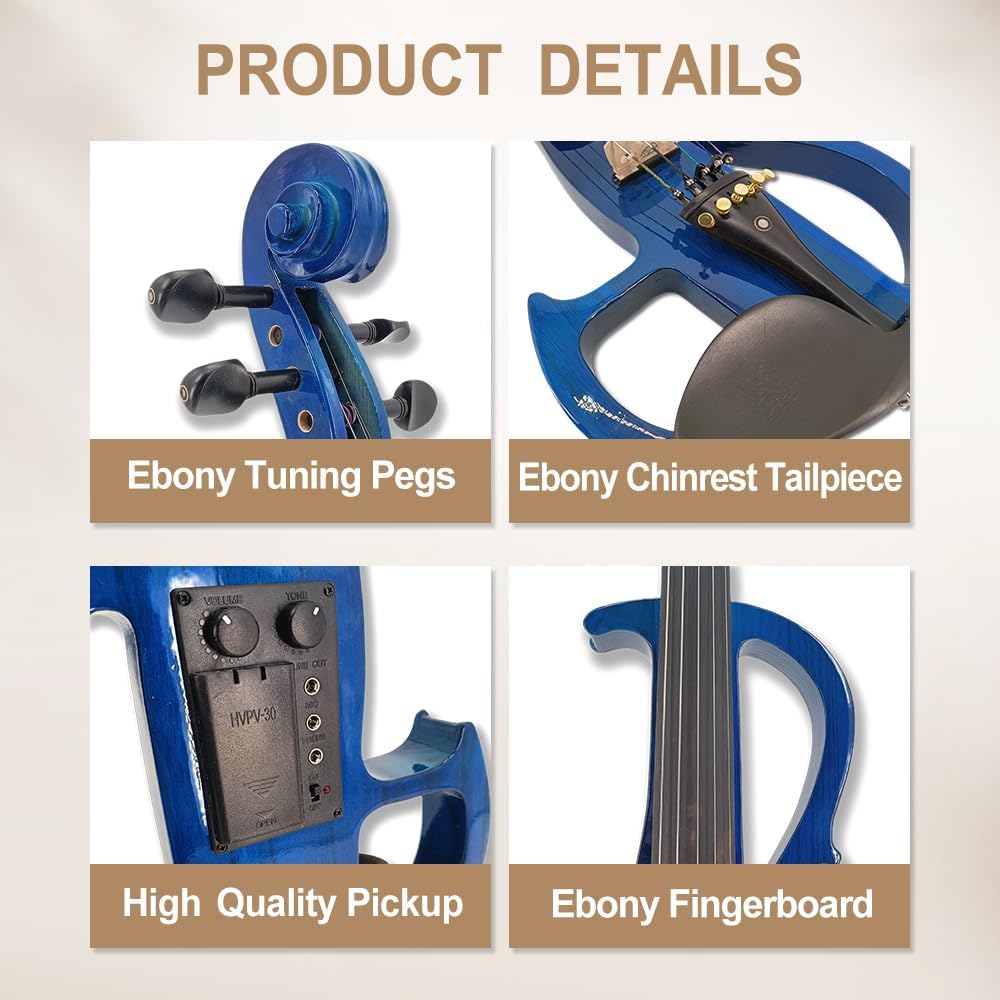
Imagine you’re a violist living in an apartment building. Your neighbors have opinions about Bartók études at 10 p.m. You know an electric instrument — one that routes sound through headphones instead of vibrating a wooden body — would solve the noise problem. But when you search “electric viola,” the results are thin, weirdly expensive, or clearly just labeled-up violin bodies with a slightly longer neck. Sound familiar? That’s the electric viola problem in one paragraph.
An electric viola (sometimes called a silent viola) is a stringed instrument designed to be played with a bow like a traditional viola, but it produces almost no acoustic sound on its own. Instead, it uses a pickup — a small sensor — to convert your string vibrations into an electrical signal, which you route to headphones, an amplifier, or a recording interface. The viola is the slightly larger, deeper-voiced sibling of the violin; its strings are tuned C–G–D–A rather than the violin’s G–D–A–E, and that lower pitch range changes what a pickup needs to do well. This guide will walk you through the real tradeoffs, name the instruments worth considering at each price tier, and give you a clear decision rule before you spend.
Why the Electric Viola Market Is Smaller (and What That Costs You)
The honest answer is scale. As Strings Magazine’s annual gear survey consistently notes, electric violins outsell electric violas by a wide margin — estimates typically run four-to-one or higher at the retail level. Manufacturers respond to demand, which means fewer models, fewer colorways, and crucially, fewer owner reviews to triangulate from before you buy.
That thinness creates three specific buying risks that don’t affect the violin side nearly as much:
1. Mislabeled instruments. A meaningful number of entry-level “electric violas” sold online are standard 4/4 violin bodies with viola strings forced onto a slightly adjusted bridge. The body length of a 4/4 violin is around 356mm (14 inches); a playable viola typically starts at 380mm (15 inches) and goes up from there. A violin-sized body won’t give you the lower-midrange resonance that makes a viola’s C string usable — even through a pickup. Forum threads on violinist.com document this frustration repeatedly: players buying budget instruments and finding the C string muddy or acoustically choked.
2. Pickup systems tuned for violin frequencies. Standard piezo pickups (pressure-sensitive sensors typically mounted under the bridge or inside the instrument) are often voiced for the violin’s higher register. On a viola, an under-voiced pickup will produce a thin or nasal tone on the lower two strings. This is a fixable problem at mid-tier and above — manufacturers like NS Design and ZETA engineer their systems with the full viola range in mind — but it’s a real trap at the entry level.
3. Fewer used-market options. On Reverb in May 2026, a search for used electric violins in the $300–$800 range returns dozens of listings. The same search for electric violas returns a fraction of that. If you miss a deal, the next one may be months away.
By the Numbers
| Body Length | Category | Typical Price Range (new, 2026) |
|---|---|---|
| ~356mm (14”) | Often mislabeled viola / actually violin-sized | $80–$200 |
| ~380mm (15”) | Entry to mid electric viola | $150–$600 |
| ~400–410mm (16–16.5”) | Mid to pro electric viola | $400–$2,500+ |
| Custom / commission | Luthier-built electric viola | $3,000–$8,000+ |
Pickup Systems: The Decision That Shapes Your Tone
Before you look at specific instruments, understand the pickup decision — because it determines not just your tone but your entire signal chain downstream.
Piezo pickups are the most common type in electric violas at every price tier. They detect physical vibration directly from the bridge or top plate. The upside: they respond to every nuance of your bow — pressure, speed, spiccato articulation — because they’re feeling the mechanical event directly. The downside: they can sound brittle or harsh without a proper preamp stage to buffer the signal. Sound On Sound’s technical feature on piezo vs. magnetic pickups for bowed strings explains this clearly: piezo pickups have very high impedance output, meaning they need a preamp (either built into the instrument or in a separate DI box) to interact cleanly with standard amplifier and interface inputs. Running a raw piezo into a standard guitar amp input is one of the most common beginner mistakes, and it produces a thin, quacky tone that wrongly gets blamed on the instrument.
Magnetic pickups detect the magnetic field disruption caused by steel strings moving through a coil — the same physics as a guitar pickup. They produce a warmer, more “electric” character with natural compression. The tradeoff: they require steel or steel-core strings to work at all, which changes bow feel and limits your string options. ZETA’s designs have historically leaned toward magnetic systems for this warmer character, while NS Design uses a proprietary Polar pickup system that blends magnetic and piezo elements.
The practical decision rule: If you want to sound like a viola — complex, reedy, capable of dark orchestral tone — lean toward a well-implemented piezo with a quality preamp. If you’re playing in a band context where you want to cut through a mix with a voice closer to an electric guitar in feel, a magnetic or hybrid system gives you more of that.
At the silent-practice end of the use case, pickup character matters less than you’d think (you’re mainly practicing technique, not auditioning for a record), but it matters enormously the moment you plug into a PA.
Tier-by-Tier Breakdown: What You Actually Get
Entry Level ($80–$250): Proceed With Specific Caution
The Cecilio CEVN-1 and Mendini MV300 have violin equivalents at this price. Their viola counterparts exist in name, but the body-size issue described above is most acute here. If you’re considering this tier, measure the stated body length before purchasing. Any reputable listing will provide this; if it doesn’t, that’s your first warning.
The use case where entry-level works: a young student who needs silent practice for 6–12 months while they decide whether viola is their instrument. For that purpose — headphone practice only, no amplified performance — a $150 instrument that’s actually viola-sized and has a functional piezo under the bridge is good enough. Owners across aggregated forum reviews consistently report that the preamps at this tier are marginal: expect to upgrade to a passive DI box (around $30–$50) fairly quickly if you want cleaner headphone tone.
Mid-Range ($350–$700): The Sweet Spot for Serious Silent Practice
This is where instruments start being purpose-built for the viola register. The Bridge Draco Viola (around $400–$500, available in 15” and 16” body options) earns consistent praise from advancing players for its balanced C-string response. Strings Magazine’s gear coverage has noted the Draco series as among the more thoughtfully voiced mid-tier options for viola specifically.
The Yamaha Silent Viola SV-255 (typically $500–$650) is the most frequently recommended instrument in this tier across community discussions on violinist.com. Yamaha’s silent instrument engineering is well-documented: their SVC and SVV series for cello and violin respectively share the same core design philosophy — a resonance chamber built into the body that allows some acoustic feedback to the player through the chinrest and shoulder rest contact points, reducing the “dead” feel that troubles many players on fully solid-body instruments. Owners consistently report that the SV-255 feels closer to a conventional viola under the hand than competing solid-body designs.
The tradeoff to name explicitly: Yamaha’s onboard preamp and headphone output are optimized for practice. The line output for stage use is functional but limited compared to what you get at the next tier. If 80% of your use case is silent practice and 20% is occasional small-venue performance, the SV-255 is a strong answer. If the ratio flips, keep reading.
Professional Tier ($1,200–$2,500+): NS Design and ZETA
The NS Design CR Viola ($1,200–$1,800 depending on configuration, listed at Sweetwater and other major retailers) is the closest thing this tier has to a standard reference instrument. The Polar pickup system captures both magnetic and piezo signals, blendable via onboard controls. The ergonomic body design with a built-in shoulder support — NS Design’s “NXT” and “CR” framing — has been widely discussed in Strings Magazine’s coverage as a genuine solution for players who find solid-body instruments uncomfortable over long practice sessions.
The ZETA Jazz Viola, when available (the ZETA line has had periodic availability gaps as of mid-2026), runs $2,500 and above. ZETA’s magnetic pickup voice is distinctive — warmer and more even across strings than many piezo systems — and their instruments have a long reputation among touring players who need stage reliability. The Strad has referenced ZETA instruments in feature coverage on crossover string performers precisely because of that live-performance track record.
The decision frame for this tier: If you are a working player who needs silent practice and stage performance from the same instrument, the NS Design CR is the more pragmatic choice because its signal path is more flexible and its supply chain is more reliable in 2026. If your stage sound specifically needs the ZETA magnetic character and you can wait for stock, that premium is defensible.
Custom Luthier Commissions ($3,000+)
A handful of boutique luthiers build electric violas to player specification — body size dialed to your preference, pickup system chosen before construction rather than retrofitted, wood and finishing choices that affect resonance through the instrument’s body contact points. This tier makes sense if you have specific ergonomic requirements (viola body size is genuinely personal in a way violin size isn’t) or if you’re building a performance rig where every element needs to be optimized together. The cost reflects true craft labor, not marketing margin.
The Amplification Chain You’re Also Buying
Whichever instrument you choose, budget for its signal chain. A common mistake — documented repeatedly in forum discussions and gear review aggregations — is spending $600 on the instrument and routing it through whatever is handy.
A workable silent-practice chain at any tier: instrument → headphone amp (a unit like the Headway EDM-1 preamp or similar acoustic DI/preamp, typically $150–$250) → headphones with flat response (not consumer “bass boost” headphones, which will mis-represent your tone). A workable stage chain adds: a quality passive or active DI box → PA system or dedicated instrument amplifier.
The onboard preamp on instruments like the Yamaha SV-255 handles the headphone step natively. Above that tier, NS Design and ZETA both include buffered outputs that interface cleanly with standard equipment.
Your Decision Rule
If you need silent home practice and your budget is under $600: The Yamaha SV-255 Silent Viola is the single most defensible choice based on aggregated owner feedback and Yamaha’s documented engineering on this specific use case. Verify you’re buying the viola, not the violin version.
If you need one instrument to cover both silent practice and live performance at a professional level: The NS Design CR Viola is the clearer answer in 2026. Its pickup system, onboard controls, and build quality are purpose-built for that dual use.
If body sizing is your primary concern and you’re between 15” and 16.5”: Price the Bridge Draco in both available sizes before committing. At $400–$500, it’s the mid-tier option most willing to meet you at your actual playing dimensions.
Your next step: cross-reference any instrument you’re seriously considering against current Reverb listings for used examples — the electric viola used market is thin but real, and a lightly used NS Design CR at $900 is a materially different decision than a new one at $1,500. Check Sweetwater’s current NS Design CR Viola listings for published specs and current street pricing before your final number.