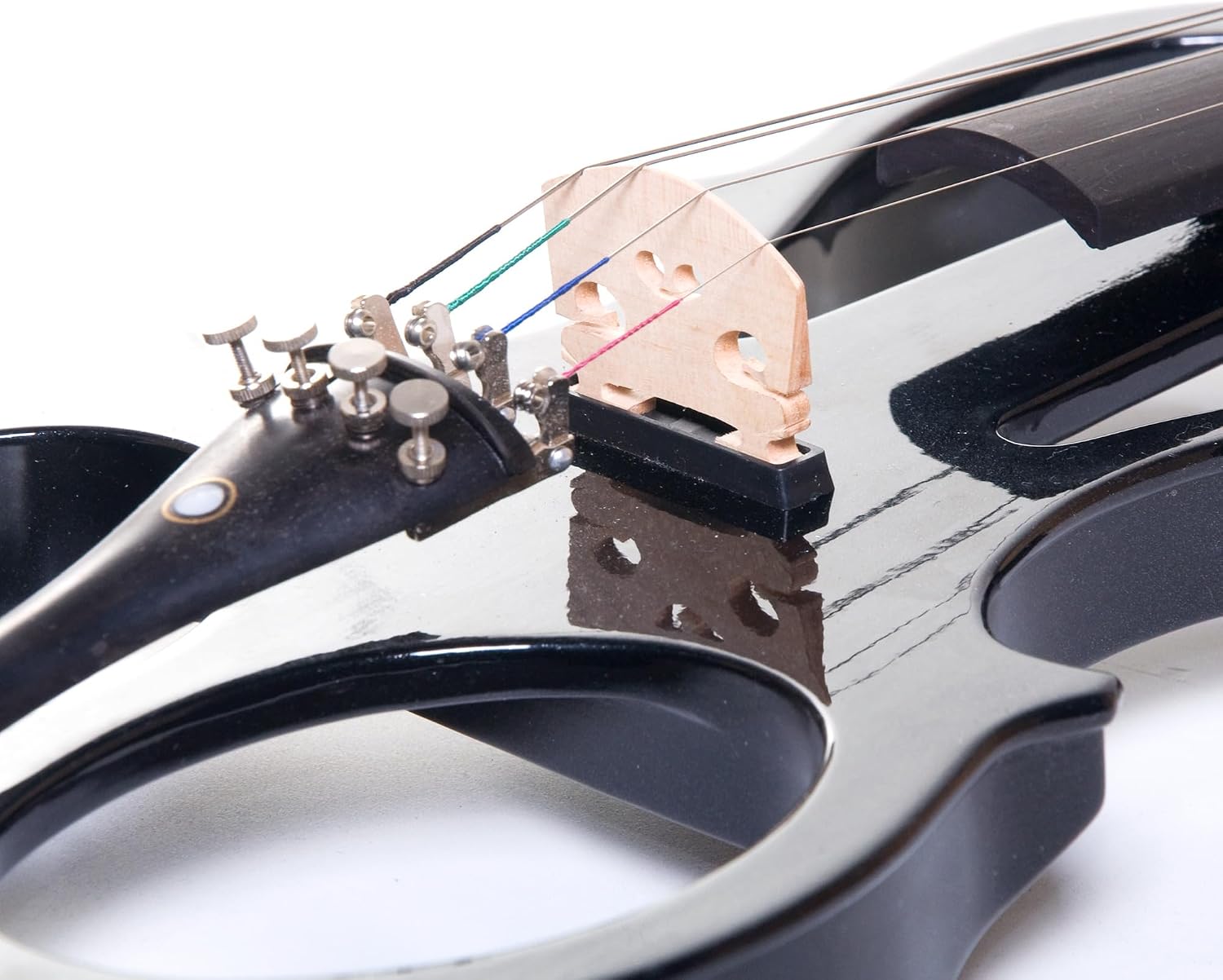
Imagine you’ve been playing acoustic violin for a year or two, and your neighbors — or your family at 11 p.m. — are starting to give you that look. A silent practice violin (also called a solid-body electric violin) solves that problem: instead of a hollow wooden resonance chamber that projects sound into the room, it uses a built-in pickup — an electronic sensor that converts string vibration into an electrical signal — routed through headphones so only you can hear yourself. You practice at full intensity; the room hears almost nothing. These instruments cluster heavily in the $80–$200 range, and from the outside they can look nearly identical. But the differences between a $90 model and a $180 model are real, consequential, and rarely explained clearly. This guide maps exactly what each $50 price step actually buys you — and where the law of diminishing returns kicks in — so you can match your budget to your actual practice goals.
| EDITOR'S PICK[Kinglos 4/4 White Blue Flowers](https://www.amazon.com/dp/B01N904YV8?tag=greenflower20-20)… | Mid-tier[Cecilio Solid Wood Electric/Sil](https://www.amazon.com/dp/B003F1TDBS?tag=greenflower20-20)… | Budget pick[Cecilio Electric Violin 4/4 Ful](https://www.amazon.com/dp/B003F1PK42?tag=greenflower20-20)… | |
|---|---|---|---|
| Body material | Solid wood | Solid wood | Solid maple wood |
| Finish/Color | White blue flowers | Metallic red mahogany | Metallic black |
| Kit included | ✓ | — | ✓ |
| Price | $227.99 | $151.99 | $119.99 |
| See on Amazon → | See on Amazon → | See on Amazon → |
Why the Price Ladder Matters More Than the Brand Name
At this tier, marketing language is almost useless as a decision tool. Every product in the $80–$200 window claims “professional tone,” “studio quality,” and “premium materials.” What actually shifts as the price climbs is a short list of mechanical and electronic variables that have outsized effects on playability and longevity.
Sweetwater’s electric violin buying guide identifies pickup quality, preamp output, hardware consistency, and body ergonomics as the four levers most buyers feel immediately. At the budget end of the market, manufacturers are compressing costs somewhere on that list. Your job as a buyer is to figure out where.
Here’s the honest architecture of the under-$200 market as of mid-2026:
By the numbers:
- ~$80–$100: Entry tier. Piezo pickup, passive output (no onboard preamp), minimal hardware tolerances.
- ~$130–$150: Mid-entry. Basic onboard preamp, improved tuning machines, sometimes a better bridge fit.
- ~$170–$200: Upper entry. Active preamp with headphone amp built in, tighter QC on fittings, usable bow included.
Let’s walk each step.
The $80–$100 Tier: What You’re Actually Buying
The Mendini MV300 (street price around $80) and instruments in its class represent the floor of the functional silent-practice market. At this price point, manufacturers are essentially delivering a shaped piece of solid tonewoods — usually basswood or a maple-look composite — with a piezo pickup (a pressure-sensitive crystal element mounted under the bridge saddle that picks up vibration mechanically) wired to a passive output jack.
The word “passive” is load-bearing here. A passive output means there’s no battery, no onboard amplification. The raw piezo signal is thin and high-impedance — meaning it needs to flow into an external headphone amp or audio interface before you hear anything useful. The instrument itself ships with a mini practice amp or headphone adapter in some bundles, but that included hardware is almost always the weakest link in the chain.
Owners across aggregated Reverb and retailer reviews consistently report three patterns at this tier:
- Tuning instability in the first weeks — the pegs are friction-fit (no mechanical gear ratio), so string tension changes with humidity and handling. You’ll tune more often than on a geared instrument.
- Inconsistent bridge fit — the bridge (the small carved piece of wood holding the strings off the body) may not be precisely fitted to the instrument’s arch, which affects both intonation and pickup contact.
- The bow is usually the first thing players replace — included horsehair bows at this price rarely hold rosin well enough for reliable tone.
The honest tradeoff: You’re buying proof-of-concept — a working instrument that confirms silent practice fits your life before you invest more. If you practice three days a week and decide it’s not for you in three months, you’ve lost $80, not $200. That’s a legitimate use of this tier.
What you are not buying: stage reliability, tonal character worth describing, or hardware that will feel the same from unit to unit. MusicRadar’s best electric violins roundup notes that budget instruments at this price point show “significant variation in setup quality between individual units” — which is the polite way of saying QC is inconsistent.
The $130–$150 Tier: Where the Pickup Chain Gets Usable
This is the most important price jump on the ladder, and it’s the one most buyers underestimate.
Instruments like the Cecilio CEVN-1 (street price approximately $100–$130 depending on bundle) and close competitors around the $140 mark introduce an onboard preamp — a small battery-powered circuit built into the instrument body. The preamp does two things: it buffers the piezo signal (stabilizes its impedance so it doesn’t sound thin and brittle through headphones) and often adds a basic volume control and sometimes a tone knob (a simple filter that rolls off high-frequency harshness).
The practical effect is significant. Violinist.com’s community discussions on electric violin budget instruments consistently show players reporting that this single change — passive to active preamp — produces the largest perceived tone improvement in the sub-$200 range. You’re not getting audiophile electronics. But the signal going into your ears stops sounding like you’re playing through a telephone.
Hardware also tends to tighten up here. Strings Magazine’s overview of entry-level electrics notes that instruments in the $130–$150 range more often ship with planetary or worm-gear fine tuners at the tailpiece, which dramatically reduces the time you spend fighting pitch. The friction pegs may still be present, but with fine tuners doing the micro-adjustments, they matter less in daily practice.
The honest tradeoff: This tier is right for players who are committed enough to practice four or more days a week and want the friction of setup to stop eating into practice time. The jump from ~$90 to ~$140 is measurable in daily quality-of-life. If your budget allows it, this is the minimum tier worth recommending for anyone who already knows they’ll stick with it.
What you’re still not buying: a built-in headphone amp. Most instruments in this range output a standard 1/4-inch jack signal, so you still need an external headphone amplifier (a small battery-powered box, typically $20–$40 separately) or an audio interface to practice silently through headphones.
The $170–$200 Tier: The All-In-One Practice Package
The upper edge of the budget window — instruments like the upper-tier Cecilio CEVN variants and competitive models near $180–$200 — typically deliver one headline feature the tiers below don’t: a headphone output built directly into the instrument’s preamp circuit.
This sounds minor. It isn’t. The ability to plug headphones directly into the violin — no extra box, no interface, just the violin and your headphones — removes the most common practical barrier to daily silent practice. You pick it up, plug in, and play. Sweetwater’s buying guide specifically highlights this as a key differentiator for beginners evaluating the top of the budget market, noting that “all-in-one functionality significantly reduces setup friction for home practice scenarios.”
You also tend to get, at this price:
- A better quality horsehair bow (still not great, but noticeably more playable)
- A more substantial case with actual neck support
- Improved shoulder rest fitment
- Sometimes a basic onboard EQ (equalizer — a set of tone controls that let you adjust bass, midrange, and treble balance)
The honest tradeoff: You’re paying a $50–$80 premium over the mid-entry tier primarily for convenience and packaging. The underlying electronics aren’t dramatically better — you’re not getting a meaningfully superior pickup or preamp circuit. If you already own a headphone amp or audio interface, the extra spend is harder to justify on pure performance grounds. If you’re starting from zero and want one box that works, this tier earns its price.
Where the Law of Diminishing Returns Kicks In
Above $200, you leave the silent-practice-tool market and enter the stage-capable instrument market. The next meaningful step up — instruments like the Yamaha YEV-104 at around $500 — represents a fundamentally different design philosophy: shaped acoustic chamber for natural resonance, Yamaha’s proprietary pickup system, and hardware tolerances that hold up to touring. It’s not a bigger version of the under-$200 instruments; it’s a different category.
For pure silent home practice, the gains from spending above $200 are real but marginal until you’re at the $400–$500 level where the instrument becomes a dual-purpose tool (practice and performance). The mid-entry tier ($130–$150) is the sweet spot for most dedicated students. The upper entry ($170–$200) is the right call if setup friction is a real barrier to your consistency.
Across the full sub-$200 market, Bridge Draco and ZETA-level pickup performance it is not — and shouldn’t be evaluated as such. These are practice instruments. Judge them on whether they make you practice more consistently, not on whether they sound like a $2,000 rig.
The Decision Rule
Here’s the if/then framework that covers most buyer situations:
- If you’re testing whether silent practice fits your life at all, and you have an audio interface already → ~$80–$100 tier — prove the concept before committing.
- If you’ve confirmed you’ll practice regularly and want to stop fighting the instrument → ~$130–$150 tier — the preamp jump is worth it every time.
- If you’re starting from zero with no existing audio gear and want one-cable simplicity → ~$170–$200 tier — the headphone-out convenience pays back daily.
- If you’re already thinking about gigging or recording sessions in the same breath as practice → skip this tier entirely and save toward the Yamaha YEV-104 or Bridge Draco — the instrument will serve both purposes and hold its resale value far better.
Your next step: Before you buy, cross-check the specific model you’re evaluating against recent owner reviews on Reverb — filter for reviews in the last six months to catch any manufacturing batch issues. At this price tier, QC variance between production runs is one of the most underdiscussed purchase risks, and current owner feedback is the most reliable signal you have.